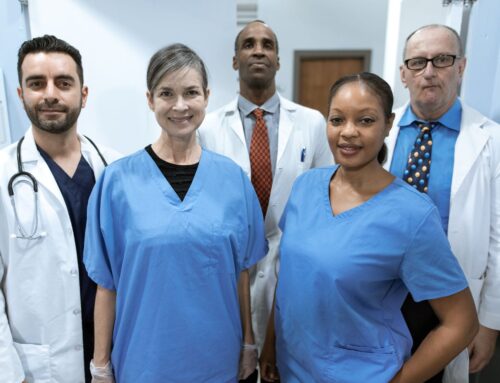
Is nursing a job? A profession? A vocation? Although Florence Nightingale saw nursing as an independent profession that was not subordinate but equal to the medical profession, for a long time the nursing profession was seen as inseparable from the medical profession. There are approximately 350,000 Registered Nurses practising right now in Australia. That’s about 1.5% of the population and yet nursing is still one of the fastest-growing occupations. In fact, the country is currently facing a nursing shortage unlike any other before. Nursing is still seen as a vocation by many, but in truth, it is a vital profession and a role that all Australians will probably need at least once in their lives.
Nursing is essential for a smooth-running healthcare system. Nurses are far from one-trick employees – they perform countless vital tasks in hospitals, nursing homes, schools, and more. The number of nurses on hand (or a lower nurse-to-patient ratio) has been directly related to patient survival and recovery without additional complications.
But nursing isn’t an easy job. Over half of nurses report that stress and frustration plague them daily in their job. However, most nurses also agree that their job is extremely fulfilling. Very few careers are as directly related to public health and serving the community as nursing. Also, the public is genuinely grateful for nurses. An annual survey of more than 3,000 Australians found that doctors were the most trusted of any profession, after the COVID-19 pandemic put health in the spotlight. Nurses and paramedics rounded out the top three of the Trusted Professions poll, while scientists were ranked fifth overall.
Author Karolyn White argued in a 2002 journal, that “nursing is best understood as a vocational occupation. Using Blum’s model of vocations, it is argued that such occupations are socially expressed within practices embodying traditions, norms and a range of meanings: industrial, social, personal and moral. Vocational workers are those who identify in certain ways with these traditions, norms and meanings.”
White went on to discuss that “One problem with the vocational model, as it has historically applied to nursing, is that it has been articulated through concepts of motherhood. Nursing was a vocation precisely because the character of the nurse was identified as feminine.” She continued, saying “the vocational model for nursing can be conceptually disentangled from its identification with ideals of motherhood and femininity. It is nursing work and the identification with the moral and social meaning of nursing that give nursing its vocational status, not the feminized character of the nurse.”
However, nursing remains one of the highest jobs in demand and is growing fast. More and more students will obtain their Bachelor of Nursing in 2021/2. Since this profession is growing rapidly, it is a good idea to take the steps needed in order to become stable in this field.
The path to a nursing career is straightforward, though entails long hours of study and placement work. Firstly, you need to graduate from high school. In order to be considered for entry into a tertiary education program in nursing, students must have completed their HSC or another state-based equivalent. Some universities will also require you to have completed prerequisite subjects.
Next, you’ll study for your Bachelor of Nursing. To become a nurse, you must complete an accredited Bachelor of Nursing degree at University. Accreditation is granted by the Australian Nursing and Midwifery Accreditation Council and approved by the NMBA. For school leavers, some Universities offers an NMBA accredited three-year program called the Bachelor of Nursing (Advanced Studies). This course provides students with the scientific and health-related knowledge and skills required for a career in nursing. You will also gain over 800 hours of clinical experience. The unique advanced studies component of the course also helps students to cultivate non-technical skills in leadership, research and a better understanding of the international health landscape. For guaranteed entry into this course, students must achieve an ATAR of 84 or IB of 30. There is also an English language requirement depending on your educational background and country of origin.
For those who may be looking for a career change and have already completed an undergraduate degree in an area different to nursing, most Universities offer a Master of Nursing. This two-year accredited program also comprises health theory and hands-on practical experience.
Once you have graduated, you may wish to undertake a graduate program to help you find an area of speciality and to ease you into the workplace. However, this is not mandatory.
Registered nurses can go on to pursue careers in a number of different health specialities, including emergency nursing, mental health nursing and cancer and haematology nursing just to name a few. Many speciality areas look favourably on applicants who have completed postgraduate education in these fields, as this additional study helps nurses to build on their clinical experience, knowledge and skills. It also assists nurses to extend their capabilities for professional practice and leadership.
Further study is essential if you are looking to take the next step in your career and advance to a role as a clinical nurse specialist, nurse educator, clinical nurse consultant or nurse practitioner. These leadership roles support you to deliver sophisticated, complex care, take on extra responsibilities and often attract a higher salary.
Nursing certainly has it all. It’s not only a vocation that is truly admired by every Australian, it’s a profession that can grow with you as you progress, and become a lifelong career that is as rewarding as it is appreciated.